Showing posts with label war. Show all posts

November 21, 2020

Tour Report: Air Raid Shelter below Berlin (II)

A bird never flew on one wing. That was our thought as we exited the first air-raid shelter that our friend Toeppi had organized for us to visit. So we got on the way to fill this lack of bunkers with yet another air-raid shelter.

This second shelter was below a kindergarten, and the access tunnel was right on a municipal contruction yard. We just walked across to the offices, and Toeppi asked if he could show the bunker to us. The foreman said yes right away, and so we went straight to the heavy access door and climbed down the stairs. 

The bunker was in worse condition than the first one. Water had accumulated on the floor, so we had to step on bricks that someone had put there so we wouldn't get our feet wet. Obviously, the water had been dripping from the ceiling at various points. There were many dripstones - some hanging from the ceilings, others were on the floor, and some were even "growing" on wooden plates that were leaning against a wall. We checked out all of the eighteen rooms, and I took the opportunity to play around a bit with different colors of light before we went back up into daylight.

To check out all the photos, click the button below.


October 31, 2020

Tour Report: Air Raid Shelter below Berlin (I)

It was a pretty spontaneous decision. In June of 2018, we took a few days off and headed to Berlin for a bit of exploring.

We met up with our friend Toeppi from "Fotodokumentationen zu verlassene Plätze" who had a few fascinating locations for us to check out. Toeppi is an expert regarding the Berlin air-raid protection during World War II and has access to some bunkers that are otherwise inaccessible to the public, and so the first two spots were air-raid shelters in residential areas.

We'd never have suspected a bunker behind this small new metal door in a new brick wall next to a freshly renovated apartment block somewhere in Berlin. We waited there while Toeppi went into the office of the house management and came back out with a key. He unlocked the small door, opened it, and the familiar smell of stale, humid air filled our noses as we looked down a concrete flight of stairs into the darkness.

The bunker seems to have been used as a storage space after the war, but as far as we know, it has remained untouched for the largest part of the last sixty years or so. The old writings are still on the walls, and even the fluorescent color still worked after all these years.

With the knowledge of the intensity of the battle for Berlin towards the end of the war and the thousands of tons of explosives that were dropped on the city, it is impossible to imagine the horrors that the people had to endure when they were crammed together in tiny dark rooms a few meters below ground while they could hear the bombs explode above them.

When we came out, we were relieved to be back above the ground and in the sunlight. But the next bunker was already waiting for us.....


To check out all the photos, click the button below.


November 2, 2015

Oxygen Factory P.

We had spent a lot of time in the abandoned children's sanatorium, and since we were about 350 kilometers from home and it was already well past noon, there was probably only time left for one more location.
First, we tried the cultural center that was right at the center of the same city as the sanatorium, so it would've been nice to have a second location without too much distance to cover. But circling the building with the car, we could alsready see that it was ealed so tightly that there was no way in and we decided to head for the next option.
That next option proved to be a great decision.
We had decided on the Nazi's oxygen fuel factory at the V-2 site in Peenemünde.
The historical relevance of this place is obvious, and in fact, most of the main V-2 site has been turned into a museum, but some relics have been abandoned and are off limits to the public - including the oxygen factory.
We had to drive a while to get there, past many other potential sites (all promising, but none as prominent as the oxygen factory), until we finally got to the location. Conventiently enough, there was a public parking lot right next to it.
So we just had to get out of the car, crawl under the fence and we were in.
The building is in fact magnificent, I think.
In spite of the terrors it represents, its construction in the traditional form of a basilica together with the afternoon light made for a fantastic atmosphere, especially with the beginning spring letting the first leaves come out.
We were not the only people there; there were some twenty-somethings taking photos (I really hate it when people don't react friendly when you greet them with a friendly Hi on location!) and as we left, there was a couple of senior citizens (I'd think around 65 or 70), and while the woman was waiting in the car, the man crawled under the fence just as we did and started looking around.

Here are some impressions from a nice afternoon ion a great location.
To find out more about the history of this place and to check out the full gallery, click the button below!


December 7, 2013

The Bridge That Never Was - The Junkers Airplane Factory

I found this little gem while researching about a different location, and I read that there was an Autobahn bridge being built during the war that was never finished and used as a protected location for arms production during World War II.


The bridge was to become become part of today's Autobahn 44 in Germany, but since the plans for this particular marked route (parts are in construction, part is already open for traffic) have been changed to another region, this bridge will only remain am monument.
The Nazis had planned this bridge as an underpass for a forest trail and integrated into its structure a production hall for airplanes and motors.


After Hitler's seizure of power, the plans for the contruction of the Autobahn from the 1920s were taken back out of the drawer.
From April until October of 1939, the marked route was cleared and excavated, and at the same time, construction for this forest path bridge was begun and finished in spring of 1940.


This was also the time that the construction of the Autobahn was stopped because the forced laborers were withdrawn to work in various arms industries.
In 1943, the Junkers Flugzeug- und Motorenwerke built a production hall of about 200 square meters in the middle tunnel of the bridge and more production space of about 250 square meters on both sides of the bridge. This was achieved by putting roofing over the bridge that rested on walls built about 18 meters to the side.


Installed were a number of workbenches, engine lathes and vertical drilling machines. Next to Soviet P.O.W.s, Polish, Czech, Lithuanian and German workers were used, overall about 50 persons.
The entire area was fenced in and patrolled by civilian guards.
The production was pursued until the American troops invaded the area on April 1, 1945.


December 4, 2013

Code Name Friedland - The Explosives and Ammunitions Factory (Part 3)

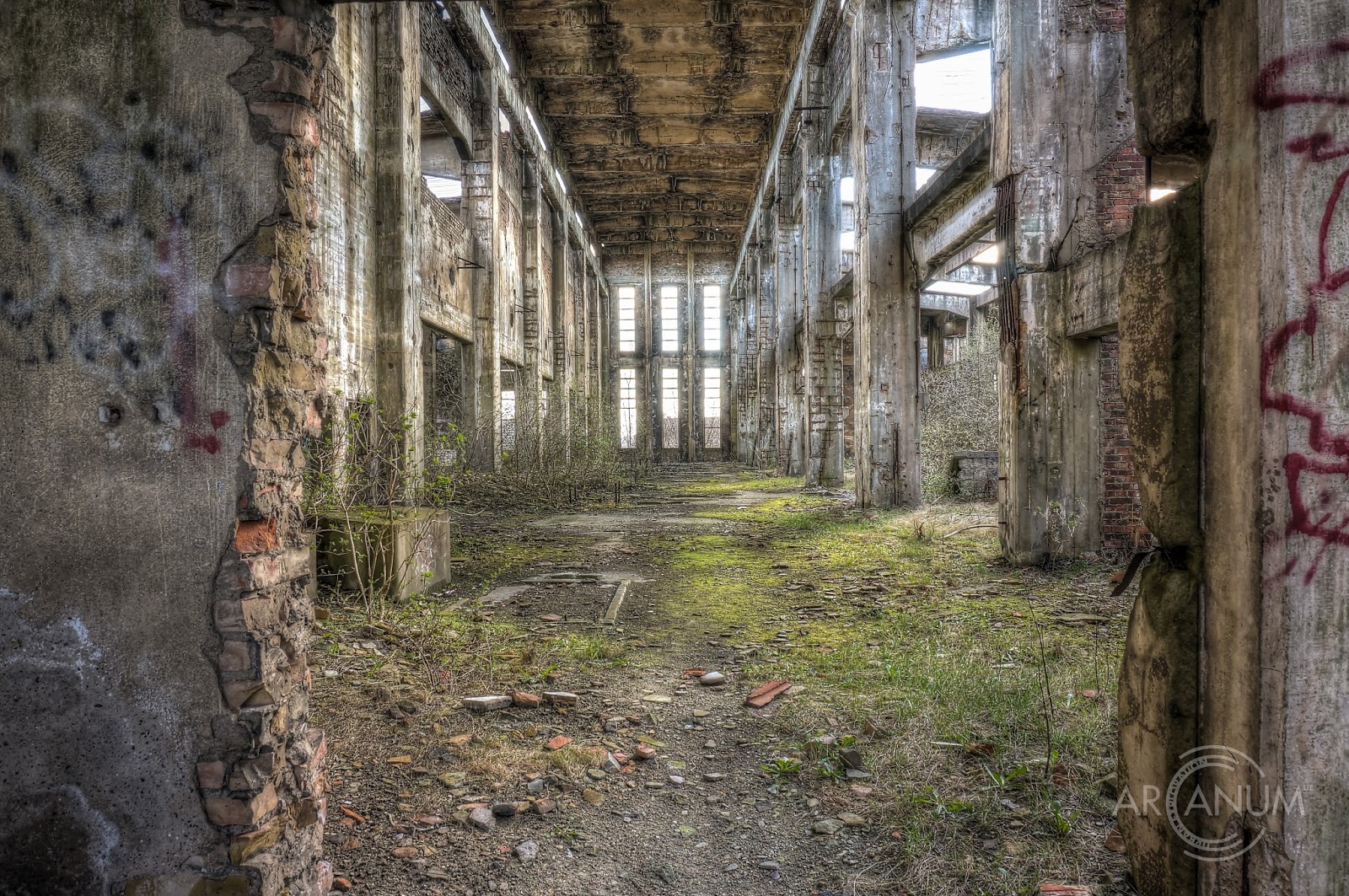
In this facility, after the construction of the Nitropenta production group had been stopped, the two explosives TNT (since 1938) and Picric Acid (since 1939) were produced until 1945.

The highest rate of production was reached in the business year 1942/43 with overall 29.170 metric tons of explosives.
In total, over the years, 118.691 tons of TNT and 5.608 tons of Picric Acid were produced.
Hence, this production site had the second highest output of all the German facilitys in this particular branch.

The production was stopped on March 29, 1945 - three days before the American troops moved into the area.
The production site was seized by the American Military Government, which ordered the local government on January 19, 1946 to shut down the facility, to supply adequate equipment and installations for the purpose of reparations and to destroy all machinery only utilizable for the purpose of war.
In accordance with the demilitarization, 148 buildings were - partly by targeted detonations - destroyed and rendered useless. Furthermore, the ramparts around the buildings and the camouflage on the roofs were removed.


Part 1 | Part 2 | Part 3
Related Posts Plugin for WordPress, Blogger...