Showing posts with label shelter. Show all posts

July 24, 2024

Tour Report:Air-Raid Shelter "Monument"

In December 2019, a good friend asked me if I would like to accompany him on a special excursion to Hamburg that night. His plan was to climb into the world's largest Bismarck memorial to take photos of the air-raid shelters underneath.
Of course, this was an opportunity I couldn't pass up.
It was planned that the renovation work, which had already been decided upon, would begin only about two months later - and that would probably mean that any further attempt in the future would be futile.
So we set off in the evening. About an hour later, we reached the park where the Bismarck monument has been located since 1906.
We found a parking space nearby and set off with our equipment.
The monument was surrounded by a wall of wooden panels in preparation for the upcoming restoration. However, there was an opening that we were able to squeeze through. And apparently not just us, because behind the passageway we discovered a small “tent city” of homeless people who were using this reasonably sheltered spot as a place to stay.
We had to climb a few steps to reach the base of the memorial, where the air-raid shelters were built using 2000 tons of concrete during the Second World War.
There was a metal door in the floor. To our surprise, it was not locked and could be opened easily.
Inside, a wooden staircase led down. Below the statue is a conical room about 15 meters high, surrounded by eight smaller rooms. This inner structure originally served to ventilate the monument.
We had to climb a few steps to reach the base of the memorial, where the air-raid shelters were built using 2000 tons of concrete during the Second World War.
There was a metal door in the floor. To our surprise, it was not locked and could be opened easily.
Inside, a wooden staircase led down. Below the statue is a conical room about 15 meters high, surrounded by eight smaller rooms. This inner structure originally served to ventilate the monument.
The interior contains murals, including coats of arms and a swastika as a sun wheel, as well as quotes from Bismarck in Gothic script that have been taken out of context. These murals were created in the course of converting the memorial into an air-raid shelter.
After a good hour, we had explored all areas of the monument and our photo tour was over.
This was a very special exploration for me, not only because of the historical significance of the memorial, but also because of the fact that it is a memorial that has been converted into an air raid shelter!

Disclaimer:
The depiction of any prohibited symbols in this article is for historical documentation purposes only!

To find out about the history of the place and to check out all the photos, click the button below.

February 27, 2024

Tour Report: Bunker "L36"

In November 2019, I received a tip that one of the remaining high-rise bunkers from the Second World War in my home town was open. Apparently someone - presumably a city employee who had checked the condition - had not properly relocked the thick padlock.
So I set off after work. It was raining heavily and my wife was kind enough to drive me the short distance and then wait for me in the parking lot. The bunker is in the middle of a residential area, so I was able to operate under cover of darkness without being seen.
The door was indeed open, and the lock was only hanging loosely in front of it - but in such a way that it was not immediately visible, which is probably why nobody had noticed it.
Through the steel door, I got inside the massive building.
The basement was completely under water, so I couldn't enter it. The condition inside is not good. The British occupying forces had blown up the bunker after the war - but from the inside, so that the massive outer walls remained standing and the residential buildings in the vicinity were not affected.
On the pictures you can see what the detonation did inside: Stairs have collapsed, walls are full of holes and the thick reinforced concrete ceilings are hanging down in pieces. All in all, the picture was somewhat surreal.
For safety reasons, I didn't venture too far into the upper floors. What's more, after about 15 minutes I came across bats that had apparently chosen the bunker as their winter quarters.
This was the time for me to retreat, as I respect the bat protection period and leave buildings as soon as it becomes clear that they are a bat hibernation site.
The excursion was very interesting, because you don't get to see bunkers this big from the Second World War every day - especially not if they are in a dangerous condition.

To check out all the photos from this amazing place and to find out more about its history, click the button below!


April 16, 2023

Tour Report: Command Post W13

After we finished our exploration of the communications bunker, we moved on to the next bunker. For this we only had to drive a short distance down the road and then a bit through the forest - actually only a short hop, but with an Audi TT on the uncleared forest roads it was already an adventurous drive.

We parked the car on a forest path next to a former guard post and made our way through the thicket. Soon we could make out some concrete parts as well as the supply and exhaust pipes.
It was quite clear - below us was the former joint command post of an air defense missile regiment and a radio engineering battalion.

The main entrance had obviously been bricked up a long time ago, but we found an open emergency exit that we could use as an entrance.
It felt like a very long way down, even if it was only a few meters in the end - but such a first entrance is quite exciting, and can distort the perception a bit :)

Through the emergency exit we first entered the room with ventilation and air conditioning. From there, we went down the hall to the radio distribution room and on to the storage room. After a short look into the airlock of the main entrance we explored the annex consisting of three FB-3 tube bunkers. After that, we headed back out into the sun - because we had two more locations to explore that day....


To find out about the history of this place and to check out all the photos, click the button below.


April 11, 2023

Tour Report: Communications Bunker "Little G"

This place was so secret that even in the paranoid bureaucacy of East Germany, there was no codename for this bunker - and it was forbidden to mention the name or the location in any case.
It was this place that my friend Lost Places in Schleswig-Holstein und Umland and I had chosen as the first of four locations on a day trip through the Northeastern part of Germany in July 2019.

I was picked up early in the morning, and about 2 hours and 200 kilometers later we were driving along a narrow road that would lead us to the bunker. When we reached a clearing where we thought the bunker was, we first saw...nothing. A radio mast next to the area showed that we were on the right track, but a bunker was nowhere to be seen. In the field, however, we could clearly see a heavily overgrown hill - the bunker hill.

So we got our equipment and set out to explore the site. There were no obvious paths, and it was all very overgrown, so we had to make our way cross-country through the bushes. Then, on top of the hill, we discovered a small antenna and some fan outlets, which showed us that we had indeed found the right place. When we then discovered the main entrance, disappointment was already spreading, because it was locked bomb-proof.

However, we were not discouraged by this, but looked for the emergency exits of the bunker. And we found one. It looked a bit like a too small toilet house - but with a very wide drain ;)
We climbed down the ladder and then had to squeeze through a narrow round hatch to get into the rooms of the bunker.

The bunker itself was quite big - a floor space of 500 square meters and about 30 rooms of different sizes wanted to be explored. The typical picture presented itself: Almost all electrical equipment was removed in the course of abandoning the bunker, and the rest was snatched up by cable thieves.

Still, it was a very interesting walk-through, because none of us had explored a bunker of this type before - and both graffiti "artists" and party-crazed teenagers had left the bunker alone until then.
So we had a very successful and exciting location to start our tour - it's always good to start the day with a sense of achievement!


To find out about the history of this place and to check out all the photos, click the button below.


January 7, 2023

Tour Report: Civil Defense Warning Station II

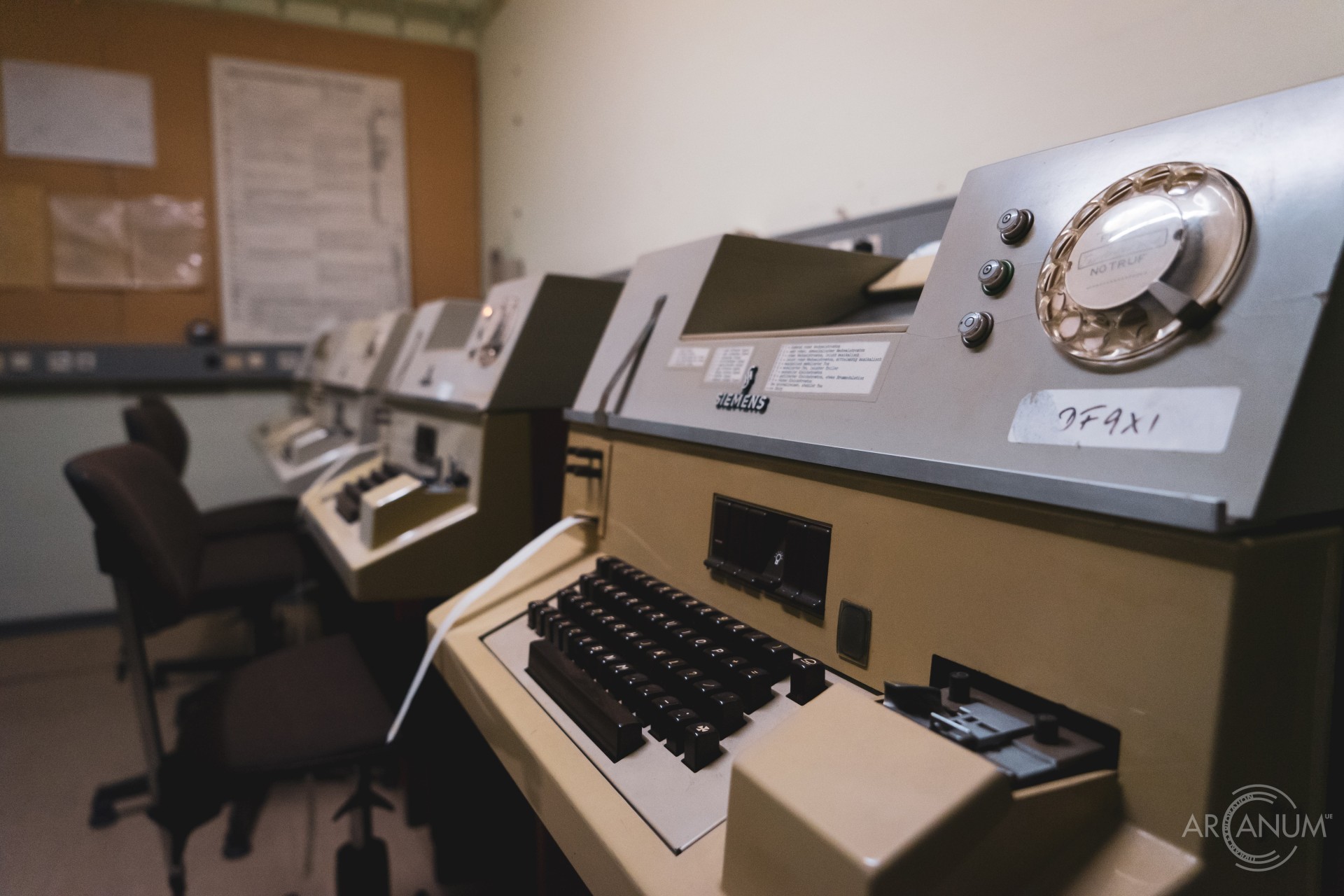
A friend of ours rents and operates the former "Warnamt II", a huge underground shelter housing one of ten German "Warning Offices" built for civil air defense during the Cold War. Since we were in the area during our Easter tour in April of 2019, we decided to pay him a visit and take a few photos.
Mirko really is doing a marvelous job keeping the place operational and expanding the collection of relics not just from the bunker's past, but from the Cold War in General.
We were joined on our tour by our friend Petra and her father, who was also very interested to see what had been built pretty close to his home...

We had announced ourselves a few days ahead, so we were greeted by Mirko, who immediately started showing us the bunker and explaining absolutely everything! He really is a wealth of information regarding the Cold War in general and the German warning system in particular. It's really interesting and a lot of fun listening to his stories - if you ever get the chance, check the place out!


To find out about the history of this place and to check out all the photos, click the button below.


Related Posts Plugin for WordPress, Blogger...