Showing posts with label World War II. Show all posts

September 28, 2024

Tour Report: WWII Maintenance Bunker [Revisit]

The last location we visited in 2019 was the remains of a bunker from the Second World War. We had already visited it a little over two years earlier, but as we were in the area anyway and didn't have too much time before the New Year's Eve party, we made a quick stop here. In fact, we walked through the forest beforehand to take a quick look at the airfield's former nuclear weapons depot. This is used by the munitions clearance service and is therefore not open to the public. We were aware of this, but wanted to have a look at least once anyway.
So back to the World War II bunker.
During the war, it was probably used as a maintenance hall for the Rechlin test site. It was blown up after the war; only the side walls remained standing. Due to the blasting, you can see the dimensions of the facility very clearly. The floor plan is rectangular with an area of approximately 1,200 square meters with wall and ceiling thicknesses of three to four meters. A huge building!
The ceiling collapsed downwards into the building as a result of the blast, so that not one stone inside is left standing on another. Over the decades, stalactites have formed on the concrete, some of which decorate the protruding steel reinforcements.
On the walls, you can still clearly see the graffiti of the Soviet soldiers who served in the Lärz airfield's radio transmitter station, which was set up on the site in an AU-13 arched shelter around 1980.
We climbed around a bit in the ruins of the bunker and took our photos. There's not much to see apart from the bunker, and the Soviet broadcasting station doesn't offer any special motifs either, as it is used by local farmers as a hay store.
So we enjoyed the sunny weather for a while and then made our way out - after all, there was a party waiting for us :)


To find out about the history of this place and to check out all the photos, click the button below.


April 3, 2024

Tour Report: Ammunition Factory and Soviet Depot F.

As we do every year, we set off on a week-long tour in November 2019 to explore a few abandoned places in eastern Germany.
The first part of our trip took us to a wooded region near a lake. There are the remains of an air munitions facility from the Second World War, which was used by the Soviets as a trophy, fuel and ammunition depot during the Cold War.
The fact that there was a public bathing area at the lake with a public parking lot played into our hands, as it wasn't far to walk and our car didn't attract any attention.
From the parking lot, it was only a few hundred meters to the main gate of the facility, which was of course locked. We could certainly have climbed over despite the barbed wire, but decided to go further into the forest and look for a hole in the fence, which we found after about 15 minutes. From there, we first had to fight our way through quite a lot of undergrowth before we reached the normal paths.
This facility is pretty big - it extends over more than one square kilometer, so we had to walk around a little more than usual.
The complex, which is secured by fences, consists of a large number of buildings and bunkers. The buildings include an administration building, the staff area with vehicle halls and workshops, a canteen and social building, a group of ammunition workhouses, the case washing facility, several packing houses and the tarpaulin hall, as well as an engine shed and the remains of the railroad line used to transport the ammunition.
We started our exploration near the main gate with the administration buildings. From there, we went past the parking garages and followed the paths to the ammunition workhouses and the packing houses. Towards the end of our tour, we found some of the ammunition bunkers that hadn't been demolished by the Soviets. In the forest, lots of remains can be found, such as the coal bunker for the railroad and the power station.
Many of the buildings and bunkers have been turned into bat habitats and are not accessible, but the place was still very interesting to explore.
Towards the end of our excursion it started to rain, so we decided not to continue our tour of the site for the time being - after all, it's good to have a few more unknown corners to revisit.


To find out about the history of this place and to check out all the photos, click the button below.




February 27, 2024

Tour Report: Bunker "L36"

In November 2019, I received a tip that one of the remaining high-rise bunkers from the Second World War in my home town was open. Apparently someone - presumably a city employee who had checked the condition - had not properly relocked the thick padlock.
So I set off after work. It was raining heavily and my wife was kind enough to drive me the short distance and then wait for me in the parking lot. The bunker is in the middle of a residential area, so I was able to operate under cover of darkness without being seen.
The door was indeed open, and the lock was only hanging loosely in front of it - but in such a way that it was not immediately visible, which is probably why nobody had noticed it.
Through the steel door, I got inside the massive building.
The basement was completely under water, so I couldn't enter it. The condition inside is not good. The British occupying forces had blown up the bunker after the war - but from the inside, so that the massive outer walls remained standing and the residential buildings in the vicinity were not affected.
On the pictures you can see what the detonation did inside: Stairs have collapsed, walls are full of holes and the thick reinforced concrete ceilings are hanging down in pieces. All in all, the picture was somewhat surreal.
For safety reasons, I didn't venture too far into the upper floors. What's more, after about 15 minutes I came across bats that had apparently chosen the bunker as their winter quarters.
This was the time for me to retreat, as I respect the bat protection period and leave buildings as soon as it becomes clear that they are a bat hibernation site.
The excursion was very interesting, because you don't get to see bunkers this big from the Second World War every day - especially not if they are in a dangerous condition.

To check out all the photos from this amazing place and to find out more about its history, click the button below!


February 25, 2023

Tour Report: Underground Junkers Factory

Continuing our tour in May of 2019, we left the abandoned "Sanatorium Hydro" to explore a place that played a part in Germany's arms industry during World War II.
Since 1943, the Nazi government had decided to relocate war-related factories underground. The companies found space mostly in old mines, railway tunnels, caverns or in newly created tunnels.
The manufacture of wings for the Ju 88 night fighter and the partial manufacture of cells for the Ju 88 and Ju 162 were among the production facilities that were relocated underground for bomb-proof production. They were relocated into a cave system in the Harz mountains that was previously used for beer storage by a restaurant in the nearby city.

We parked the car and started walking the path that took us up the hill until we reached a fence surrounding a (possibly) vacation home. There was an open door through which we could see a small entrance into the rocky wall of the mountain. We didn't know if the buildings were still in operation - it looked like the lawn was mown regularly - so we only took a quick peek. Behind the small entrance was access into the mountain, but we didn't see any way further in. So we retreated from the garden and made our way a little further up until we reached the second part of the cave system. It was wide open and easily accessible.

The day was warm, but upon entering, cool air surrounded us, which was very pleasant after the long and exhausting ascent.
Exploring places like this always is a bit ambivalent for me. On the one hand, almost 80 years ago, forced labor was used to prepare these places for production and for the production itself - so after all, the place is a place of terrible human suffering.
On the other hand, if you don't know about its history, the cave nowadays is just that - a cave, and a beautiful and exciting location to explore.

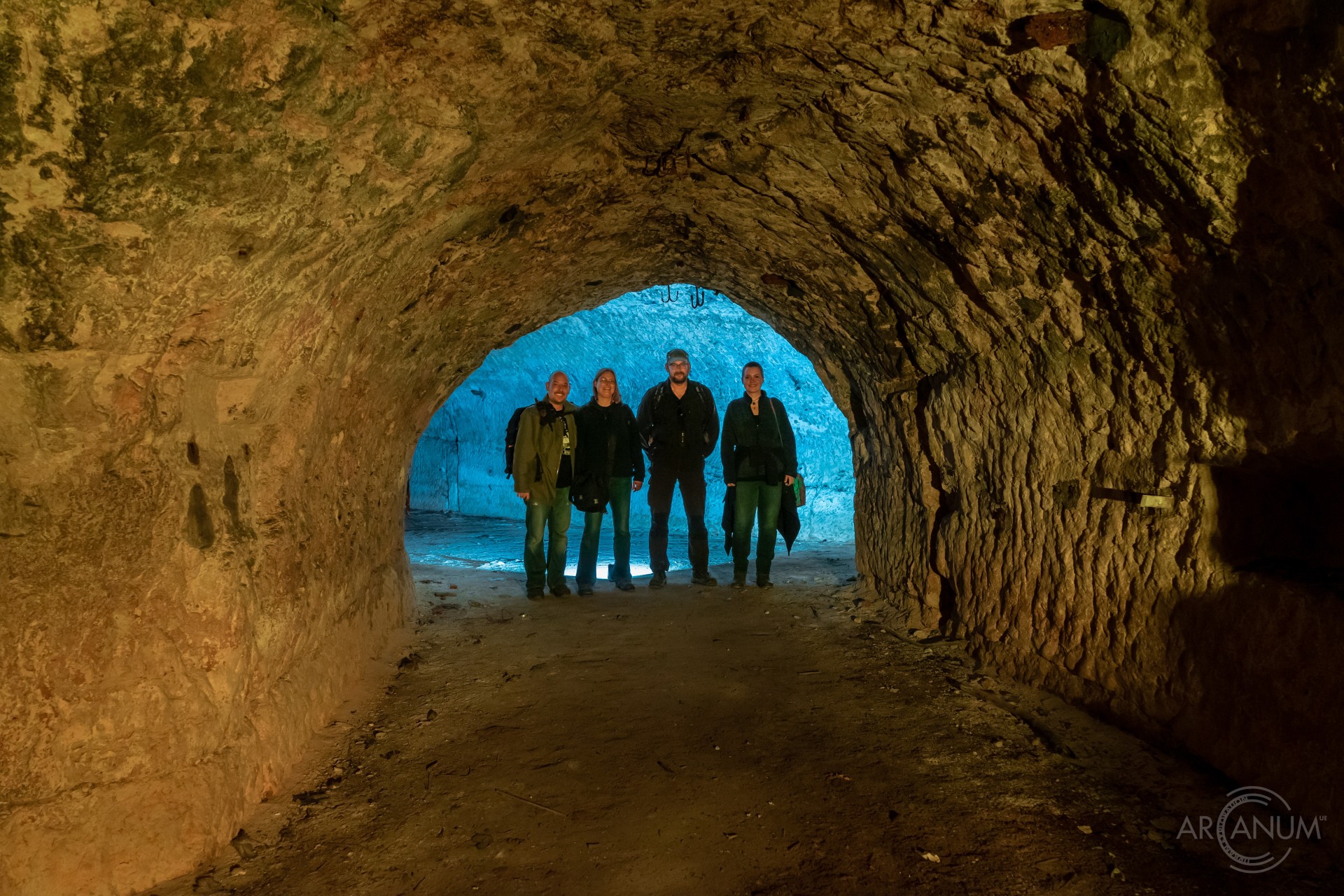
We didn't find any real relics from World War II - only a few brick walls and remains of steel beams tell the story of this cave as a war factory. When we had checked all rooms of the cave, we spent a little time flooding the place with lights of various colors - something that I had not tried before. The photos came out quite okay, I think.

I do hope that I will have the chance to explore the other parts of the cave system in the future - after all, this exploration is still incomplete ;)


To find out about the history of this place and to check out all the photos, click the button below.


July 28, 2022

Tour Report: The "Winkel" Bunker

The town of Wünsdorf south of Berlin was not only the High Command of the Soviet Forces in Germany during the Cold War and the nerve center of the Wehrmacht during World War II - it also has a very high concentration of air-raid shelters of the construction type "Winkel", so named after their inventor Leo Winkel and known for their remarkable shape that was originally inspired by the "campaniles" - free standing church towers in Italy.

Of the around 200 "Winkel-Bunkers" that were built during World War II, 19 were built in Wünsdorf alone due to the high concentration of military officials there at the time.

My business trip to Berlin had started a few days before with a great tour together with my friend Toeppi from Fotodokumentationen, and only a few days later, I got the chance for another explore! It was Wednesday, and I was able to get off work a bit earlier, so Toeppi picked me up and we drove South to check out some pointy bunkers :)

Especially one of the bunkers had sparked our interest, because there was a rumor that it was open, so we hoped that we'd be lucky enough to get an inside peek. There was a public parking area, and we only had to walk a few meters until we reached the bunker. I had seen a few shelters of this type before, but mainly near railway depots while riding a train, and I'd never seen one up close. But standing next to it, the size was pretty impressive - although it's hard to imagine 600 people crammed inside while bombs are exploding on the outside. As if to illustrate my point, there is another one of these shelters almost right next to it, that clearly shows the typical damages of artillery fire (or at least nearby explosions).

The door to the bunker was in fact open. I was surprised how clean it was. From the look of it, the bunker maybe had been used for civil defense during the Cold War, which would explain why the ventilation still looked in pretty good shape. Another possibility is that someone planned to keep it up and turn it into a museum - I don't know.

Although there wasn't much left in terms of furniture or equipment, the original writings on the wall together with the not really ample space conveyed the wish to not ever have to share a place like this with 600 other people during an aerial attack.

After we'd explored all floors of the bunker, we took the time to wander around in town to find more of the "Winkel" bunkers, and we did find a few. Most of them had been destroyed in accordance with the Potsdam Agreement - but they were just left where they were and now have become a part of the landscape and are being used as playground by children.


To find out more about the history of this place and to check out all the photos, click the button below.


Related Posts Plugin for WordPress, Blogger...