Showing posts with label bunker. Show all posts

May 29, 2026

Tour Report: Soviet Tropospheric Broadcasting Station L.

After thoroughly exploring the dusty brickworks - and making sure to stay out of the shepherd’s way - it was time to move on to the next location.

This site was one of several Soviet bunker complexes constructed during the Cold War near a former Third Reich air munitions facility. In addition to a large training ground, the area once contained various command bunkers, combat control positions, and several communications bunkers.

The structure we had chosen to explore was the site’s former tropospheric radio relay station.

As is often the case, we only had a rough idea of where exactly the bunker was located, or whether it would even still be accessible. We parked nearby and continued on foot toward the patch of forest where we suspected the complex to be hidden.

Before long, we realized we were in the right place: through the trees we spotted the ruined building that housed the entrance to the relay station.

At that exact moment, a black pickup truck drove past us and onto the property. An older man stepped out and began loading cut tree trunks onto the back of the vehicle. That immediately ruled out the standard approach to entering the site.

So we were left with three options: abandon the visit entirely, wait for him to leave — or simply walk over and ask.

We chose the third option.

The man turned out to be the owner of the property. He explained that the smaller section of the bunker complex - the crew bunker - had been sealed off as a bat habitat and was no longer accessible. However, he told us we were welcome to explore the communications bunker itself.

Simple enough.

We entered the decaying ruin, while the owner called after us that he still had an interesting story to tell once we came back out.

Inside the building, a staircase led down into the basement. One section looked like an ordinary brick cellar, while the other connected directly to the fortified relay station.

The bunker itself is relatively small. It consists of two prefabricated structures of the Soviet USB type and offers around 100 square meters of usable space. Given the remote location, the protection level was probably fairly modest by military standards.

What stood out most was the near-total absence of vandalism - the rooms were almost spotless - as well as the remarkably intact light barriers throughout the facility. These small plastic or rubber curtains were commonly used in bunkers instead of doors whenever full hermetic sealing was unnecessary, but light discipline between sections still had to be maintained.

After finishing our exploration of the bunker, the owner showed us something particularly unusual — a feature rarely encountered today.

In the cellar beneath the staircase, a small room had been separated off with a brick wall. You can see it on the second photo below. Between the top of the wall and the ceiling remained an opening barely 30 centimeters high. Rusted hinges on either side indicated that this gap had once been sealed with a barred hatch.

When the owner first took over the property, the tiny windowless room behind it still contained a metal bunk and a bucket.

It was, quite literally, a makeshift Soviet detention cell.

None of us had ever seen anything like it before, and it was difficult not to reflect on the conditions under which some Soviet soldiers must have served at sites like this.

On the way back to the car, we spent some time walking through the surrounding forest to see whether any remains of the former Soviet fuel depot could still be found. We had little success, though - apart from a few traces of the old roads, very little remained visible. Then again, perhaps we simply weren’t looking carefully enough.

To find out more about the history and to check out all the photos from this place, click the button below.


January 15, 2026

Tour Report: Soviet Command Bunker 172 ОБВП

For our trip in early October 2020, my friend Andreas and I had put several Cold War relics in northeastern Germany on our list. After taking the opportunity to photograph an old mausoleum along the way, we headed straight for our first planned location.

Our destination was a former command bunker of the Soviet Air Forces. Originally, it had been constructed as the operations center of the 20th Guards Fighter Aviation Regiment in Parchim, before later being repurposed as the command post of the 172nd Combat Helicopter Regiment - a small but telling example of how military infrastructure was adapted during the Cold War.

After roughly 45 minutes of driving, we reached the former Soviet military compound. It was easy to identify: a classic guardhouse at the entrance and a solid concrete perimeter wall left little doubt about the site’s past.

Parking directly in front of the main gate felt like a bad idea, so we left the car a bit farther away along a dirt road. According to our plan, this path should lead us around to the rear of the compound, from where we hoped to make our way inside and search for the bunker.

The plan worked out perfectly. The dirt road ran surprisingly close to the site, and before long we discovered a breach in the wall - part of it had collapsed, leaving a hole just large enough to climb through.

Since we had no precise information about the bunker’s location within the compound, we expected a lengthy search. That fear turned out to be unfounded: after only a short walk, we had already spotted the entrance.

With a floor area of roughly 150 square meters, the bunker itself is fairly unremarkable from an architectural point of view. It closely resembles other Cold War-era structures we’ve explored at former airfields. As was often the case when Soviet forces withdrew from East Germany, very few original items were left behind. This site was no exception. A handful of pieces of furniture were scattered around, though it’s hard to say whether they actually belonged to the bunker’s original equipment—at least the armchair struck me as rather doubtful.

After completing our exploration, we stepped back outside into the daylight.

There were several more abandoned buildings on the site waiting to be explored, so stay tuned - and look forward to the next post.

To find out more about the history and to check out all the photos from this place, click the button below.


December 4, 2025

Bunker of the East German State Security S.

As our 2020 summer holiday slowly drew to an end, we still had a few places on our list—spots we’d been meaning to check out before heading home. Two of them were remnants of the Cold War, and we had arranged to meet our good friend Jürgen for a small exploration.

Our first destination that day was an unfinished bunker complex once planned for the Verwaltung Rückwärtige Dienste (Administration Support Services) of the East German Ministry for State Security (MfS, Stasi). Hidden in the forest near a former MfS holiday retreat, the bunker had been under construction since 1987, but work came to a halt after the fall of the Berlin Wall in November 1989.

We met Jürgen as planned at the access road of what is now a cluster of holiday apartments. From there, we continued on foot. After a short walk, we reached the old holiday facilities once used by Stasi employees. The buildings today are little more than gutted shells, yet it’s easy to understand why people would have spent their vacations here—the location, deep in the woods and right by a lake, is genuinely peaceful.

But the bunker was what we had come for, so we moved on. Another stretch through the forest brought us to a large hall made of corrugated metal panels. At first glance it looked like an ordinary warehouse—except for the fact that it stood alone in the middle of the woods.

Inside, at the southern end, we found a “building within a building” structure. Entering it led us to the mouth of a 65-meter access tunnel made of prefabricated concrete segments. The tunnel opened into one half of a connecting corridor belonging to a Type 1/15/V2 bunker - an installation usually intended as an alternate command site for central and district-level authorities. This particular bunker was the last of its kind ever started in the GDR, and it was never completed.

The interior was mostly empty. A basic lighting system had been installed, and the water storage tanks were already in place. A few crates with Cyrillic markings remained, presumably used during the construction phase, and all pressure- and gas-tight doors had been mounted. We also stumbled across some metal bed frames, though it’s hard to tell whether they were brought in during the build or dumped there later.

One thing that stood out was the lack of graffiti. For a place like this, the walls were surprisingly untouched. Maybe the site had stayed off the radar for years—or perhaps it had simply been secured better in the past.

We took our time exploring the corridors and chambers. Outside, temperatures were well above 35°C, and the bunker’s cool air made the visit even more pleasant. Eventually, we made our way back to the car, ready to move on to the next location on our route.

To find out more about the history and to check out all the photos from this place, click the button below.




September 23, 2024

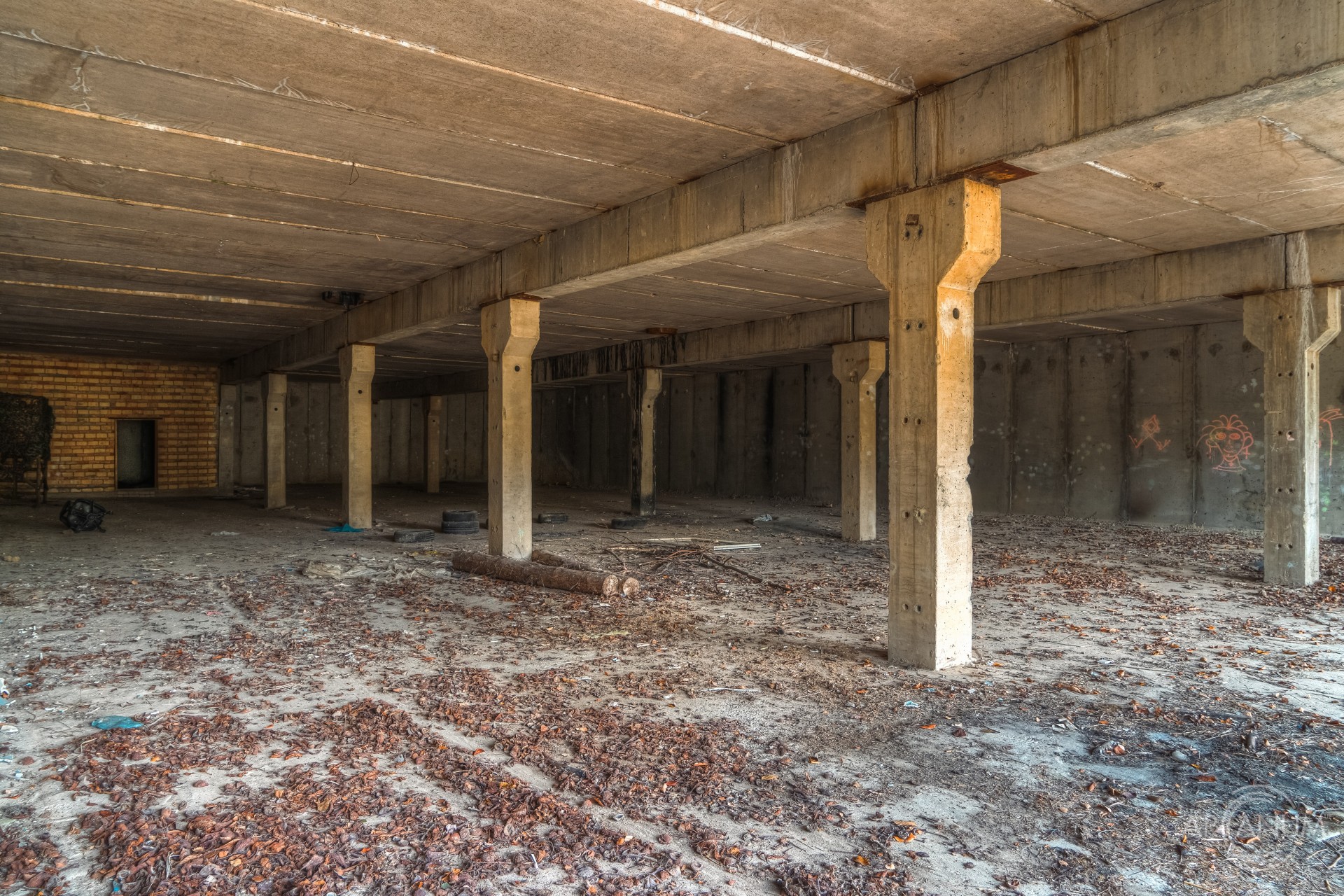
Tour Report: Soviet Ammunitions Depot R.

It was our last tour of 2019 and we had made our way to Mecklenburg-Western Pomerania with a friend to celebrate New Year's Eve at a good friend's house.
On the way, we made a short stopover to see another Soviet relic near the Lärz airfield.
Over the years we had already explored not only the airfield itself but also the bunker of the fighter control center and the command post of the 125th Fighter Bomber Division as well as the local Soviet garrison.
The object of this tour was the airfield's ammunition depot. Many Soviet airfields had two separate depots for ammunition. One depot was used to store conventional ammunition, while some airfields also had an area for storing nuclear ammunition.
In the case of Lärz airfield, the storage bunker for nuclear bombs is used by a branch of the munitions recovery service.
This bunker is located directly on the border of the airport grounds.
The ammunition depot for conventional ammunition is located a good distance north of the airfield and approx. 1.6 kilometers east of the former Soviet garrison.
On satellite images and maps, it looked as if the area was openly accessible, and so it was. We were able to park directly on the road and walked the rest of the way. We could see from the vehicle tracks that the area was probably being used as a storage site by the forestry authority.
That's why there wasn't much for us to see. The two large storage bunkers, the warehouses and the vehicle garage were locked. Only the protected vehicle hall was open and accessible. But even here there wasn't much to see apart from a bit of garbage.
So we didn't spend too much time on the site and made our way relatively quickly to another location.


To find out about the history of this place and to check out all the photos, click the button below.


February 27, 2024

Tour Report: Bunker "L36"

In November 2019, I received a tip that one of the remaining high-rise bunkers from the Second World War in my home town was open. Apparently someone - presumably a city employee who had checked the condition - had not properly relocked the thick padlock.
So I set off after work. It was raining heavily and my wife was kind enough to drive me the short distance and then wait for me in the parking lot. The bunker is in the middle of a residential area, so I was able to operate under cover of darkness without being seen.
The door was indeed open, and the lock was only hanging loosely in front of it - but in such a way that it was not immediately visible, which is probably why nobody had noticed it.
Through the steel door, I got inside the massive building.
The basement was completely under water, so I couldn't enter it. The condition inside is not good. The British occupying forces had blown up the bunker after the war - but from the inside, so that the massive outer walls remained standing and the residential buildings in the vicinity were not affected.
On the pictures you can see what the detonation did inside: Stairs have collapsed, walls are full of holes and the thick reinforced concrete ceilings are hanging down in pieces. All in all, the picture was somewhat surreal.
For safety reasons, I didn't venture too far into the upper floors. What's more, after about 15 minutes I came across bats that had apparently chosen the bunker as their winter quarters.
This was the time for me to retreat, as I respect the bat protection period and leave buildings as soon as it becomes clear that they are a bat hibernation site.
The excursion was very interesting, because you don't get to see bunkers this big from the Second World War every day - especially not if they are in a dangerous condition.

To check out all the photos from this amazing place and to find out more about its history, click the button below!


April 16, 2023

Tour Report: Command Post W13

After we finished our exploration of the communications bunker, we moved on to the next bunker. For this we only had to drive a short distance down the road and then a bit through the forest - actually only a short hop, but with an Audi TT on the uncleared forest roads it was already an adventurous drive.

We parked the car on a forest path next to a former guard post and made our way through the thicket. Soon we could make out some concrete parts as well as the supply and exhaust pipes.
It was quite clear - below us was the former joint command post of an air defense missile regiment and a radio engineering battalion.

The main entrance had obviously been bricked up a long time ago, but we found an open emergency exit that we could use as an entrance.
It felt like a very long way down, even if it was only a few meters in the end - but such a first entrance is quite exciting, and can distort the perception a bit :)

Through the emergency exit we first entered the room with ventilation and air conditioning. From there, we went down the hall to the radio distribution room and on to the storage room. After a short look into the airlock of the main entrance we explored the annex consisting of three FB-3 tube bunkers. After that, we headed back out into the sun - because we had two more locations to explore that day....


To find out about the history of this place and to check out all the photos, click the button below.


April 11, 2023

Tour Report: Communications Bunker "Little G"

This place was so secret that even in the paranoid bureaucacy of East Germany, there was no codename for this bunker - and it was forbidden to mention the name or the location in any case.
It was this place that my friend Lost Places in Schleswig-Holstein und Umland and I had chosen as the first of four locations on a day trip through the Northeastern part of Germany in July 2019.

I was picked up early in the morning, and about 2 hours and 200 kilometers later we were driving along a narrow road that would lead us to the bunker. When we reached a clearing where we thought the bunker was, we first saw...nothing. A radio mast next to the area showed that we were on the right track, but a bunker was nowhere to be seen. In the field, however, we could clearly see a heavily overgrown hill - the bunker hill.

So we got our equipment and set out to explore the site. There were no obvious paths, and it was all very overgrown, so we had to make our way cross-country through the bushes. Then, on top of the hill, we discovered a small antenna and some fan outlets, which showed us that we had indeed found the right place. When we then discovered the main entrance, disappointment was already spreading, because it was locked bomb-proof.

However, we were not discouraged by this, but looked for the emergency exits of the bunker. And we found one. It looked a bit like a too small toilet house - but with a very wide drain ;)
We climbed down the ladder and then had to squeeze through a narrow round hatch to get into the rooms of the bunker.

The bunker itself was quite big - a floor space of 500 square meters and about 30 rooms of different sizes wanted to be explored. The typical picture presented itself: Almost all electrical equipment was removed in the course of abandoning the bunker, and the rest was snatched up by cable thieves.

Still, it was a very interesting walk-through, because none of us had explored a bunker of this type before - and both graffiti "artists" and party-crazed teenagers had left the bunker alone until then.
So we had a very successful and exciting location to start our tour - it's always good to start the day with a sense of achievement!


To find out about the history of this place and to check out all the photos, click the button below.


Related Posts Plugin for WordPress, Blogger...