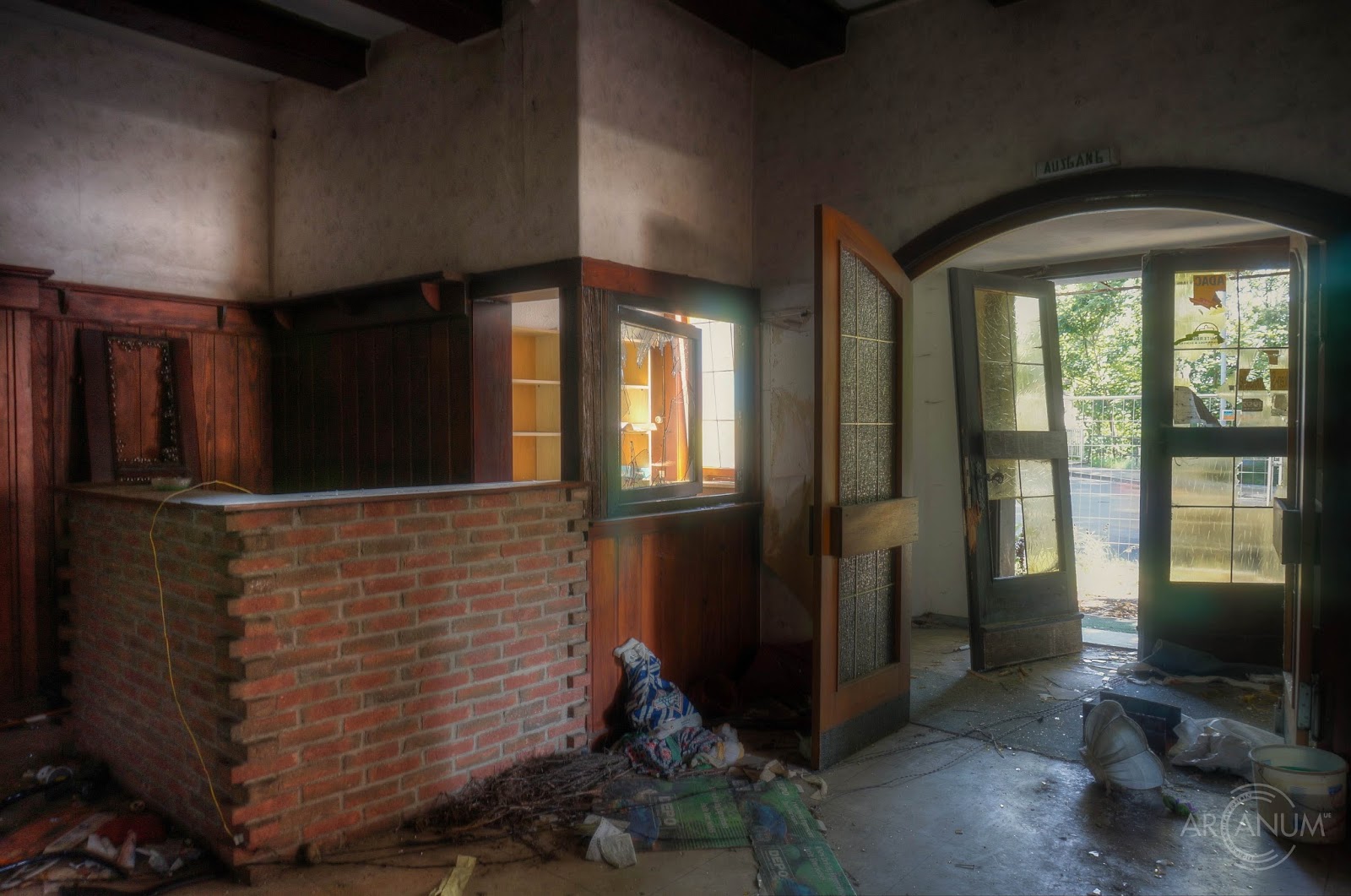
In this case, the name and location can be openly said, since this place has been demolished in November 2016, about three months after my wife and I paid a short visit to this old hotel.
It was no priority spot for us, but it was conveniently on the way between two spots and we still had some time left.
The hotel was located at the western foothills of the Harz mountains in Germany, and we had taken a tour coming from the middle of the mountain range driving west. The hotel in Barbis in the German state of Niedersachsen was kind of the point where we turned around to drive back East towards the last location of the day.
There was a large parking place right next to the ruin of the hotel, so we just used that to park our car.
The hotel was surrounded by a construction fence that was none too secure, so we easily found our way in.
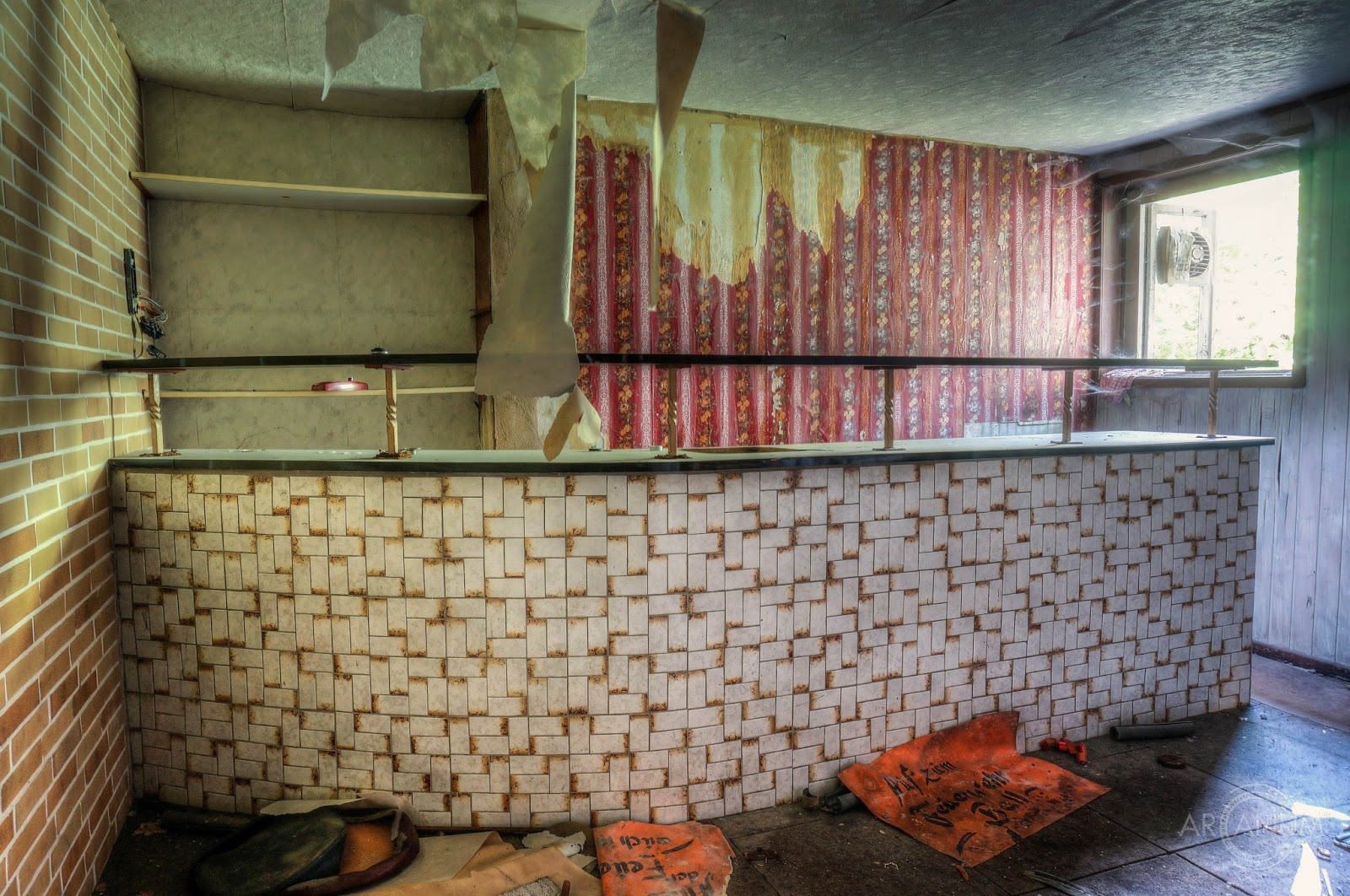
Time, vandals and various fires have taken a large toll on the old building. Hardly any furniture has been left untouched.
The only really interesting thing for me was that the kitchen had the exact same tiles that my parents used to have in our house when they built it in 1981.
To check out more galleries, click the button below.
You might say I'm a collector. I collect rare objects. Facts, stories...I travel the roads of Germany seeking its heart.
Showing posts with label leisure. Show all posts
July 8, 2017
Hotel "Zoll"
Eingestellt von
Jan Bommes
um
5:02:00 PM
Labels:
abandoned,
civilian,
decay,
demolition,
derelict,
Harz,
hotel,
leisure,
Lost Places,
Niedersachsen,
old,
R.I.P.,
ruin,
Sony NEX-6,
travel,
Urban Exploration,
UrbEx
March 29, 2015
Aqua Park B. (Part 2)
After the closure of the aqua park, only the sauna area remained in operation.
In 2012, it was closed down as well.
Over the years, there have been many plans concerning what will become of the aqua park. There were talks with the current owner about an inner city "Family Vacation Resort" with sport and entertainment opportunities, but to this day, nothing happened.
Currently, there are plans to build 400-500 living apartmentson the premises.
Here are the remaining photos from our tour there.
For the full gallery, please visit my website.
In 2012, it was closed down as well.
Over the years, there have been many plans concerning what will become of the aqua park. There were talks with the current owner about an inner city "Family Vacation Resort" with sport and entertainment opportunities, but to this day, nothing happened.
Currently, there are plans to build 400-500 living apartmentson the premises.
Here are the remaining photos from our tour there.
For the full gallery, please visit my website.
Part 1 | Part 2
Eingestellt von
Jan Bommes
um
6:27:00 PM
Labels:
abandoned,
Berlin,
civilian,
decay,
derelict building,
Forbidden Places,
leisure,
Lost Places,
old,
photography,
ruins,
Urban Exploration,
UrbEx
March 16, 2015
Aqua Park B.
This aqua park was a widely known recreation area in the eastern part of Germany.
It was opened in 1985, when Germany was still separated.
At the time, the construction cost almost 45 million Deutsche Mark, of which the state put in nine million as a non-interest-bearing loan. During the soccer season 1986/87, the aqua park became the shirt sponsor of a traditional German soccer club.
In the early years, the aqua park had about 600.000 visitors every year, but the number of visitors declined and fell to about 300.000 in the year 2001.
The manager of the park declared that it was essentially the "public character" of the park that had contibuted to its downfall.
There were massive problems with youth gangs that were getting very territorial about the pools. Three security guards were hired, but they couldn't do anything about it.
The security problems and the increasing structural decay scared off a lot of the potential visitors, especially families.
At the end of 2002, the aqua park was closed by the local health authority due to an infestation with rats, bird droppings and for the hygienic control of epidemics.
More photos in Part 2...and to view the full gallery, please visit my website.
It was opened in 1985, when Germany was still separated.
At the time, the construction cost almost 45 million Deutsche Mark, of which the state put in nine million as a non-interest-bearing loan. During the soccer season 1986/87, the aqua park became the shirt sponsor of a traditional German soccer club.
In the early years, the aqua park had about 600.000 visitors every year, but the number of visitors declined and fell to about 300.000 in the year 2001.
The manager of the park declared that it was essentially the "public character" of the park that had contibuted to its downfall.
There were massive problems with youth gangs that were getting very territorial about the pools. Three security guards were hired, but they couldn't do anything about it.
The security problems and the increasing structural decay scared off a lot of the potential visitors, especially families.
At the end of 2002, the aqua park was closed by the local health authority due to an infestation with rats, bird droppings and for the hygienic control of epidemics.
More photos in Part 2...and to view the full gallery, please visit my website.
Eingestellt von
Jan Bommes
um
11:01:00 PM
Labels:
abandoned,
Berlin,
civilian,
decay,
derelict building,
Forbidden Places,
leisure,
Lost Places,
old,
photography,
ruins,
Urban Exploration,
UrbEx
June 22, 2014
High Society - Abandoned Ballroom (Part 2)
The establishment survived World War I. Right at the riverfront there were landing stages for guest arriving with row boats or sailing ships. Internationally known singers and musicians performed here.
The place boomed during the 1936 Olympic Games when the water sports competitions were held here.
The ballroom even survived World War II and was kept in poeration during the German separation. It stayed a well-known venue and was used for cultural, social or casual events.
After the collapse of East Germany and the reunification, operation was stopped in 1991 and the ballroom was closed forever.
In 2006, a Turkish businesswoman bought the whole thing for presumably 650.000 Euros with the intention of building a conference hotel. Nothing has happened since.
A notable feature was the grand piano standing in the large ballroom.
It's not there on older photos of this location, and it sounds way too good to be as old and rotten as the building itself.
Obviously someone brought it there.
The place boomed during the 1936 Olympic Games when the water sports competitions were held here.
The ballroom even survived World War II and was kept in poeration during the German separation. It stayed a well-known venue and was used for cultural, social or casual events.
After the collapse of East Germany and the reunification, operation was stopped in 1991 and the ballroom was closed forever.
In 2006, a Turkish businesswoman bought the whole thing for presumably 650.000 Euros with the intention of building a conference hotel. Nothing has happened since.
A notable feature was the grand piano standing in the large ballroom.
It's not there on older photos of this location, and it sounds way too good to be as old and rotten as the building itself.
Obviously someone brought it there.
Part 1 | Part 2
Eingestellt von
Jan Bommes
um
8:15:00 PM
Labels:
abandoned,
Berlin,
civilian,
decay,
derelict,
Forbidden Places,
HDR,
leisure,
Lost Places,
old,
photography,
rotten,
ruins,
Urban Exploration,
UrbEx
June 20, 2014
High Society - Abandoned Ballroom
After the "German Reich" was founded in 1871, the population of the cities began to grow and at the same time the people developed the demand for diversified entertainment in their spare time.
In the suburban region of this particular city new residential districts were built, as well as establishments for water sports. Regatta courses were laid in 1880 and various leisure facilities were built.
In the time of this trend, clubs for rowing, sailing and canoeing were founded on the river and built the corresponding boathouses.
At the end of the 19th century, a couple of restaurants for day-trippers had been built to cater for the well-being of the sportsmen and visitors.
This here is one of them. Built in 1898 and abandoned in 1991, its most sepcatcular feature is the huge beautiful ballroom with a ceiling height of 9 meters.
The building itself is in danger of collapsing, and a visit is not really recommended.
Here are the first couple of pictures.
In the suburban region of this particular city new residential districts were built, as well as establishments for water sports. Regatta courses were laid in 1880 and various leisure facilities were built.
In the time of this trend, clubs for rowing, sailing and canoeing were founded on the river and built the corresponding boathouses.
At the end of the 19th century, a couple of restaurants for day-trippers had been built to cater for the well-being of the sportsmen and visitors.
This here is one of them. Built in 1898 and abandoned in 1991, its most sepcatcular feature is the huge beautiful ballroom with a ceiling height of 9 meters.
The building itself is in danger of collapsing, and a visit is not really recommended.
Here are the first couple of pictures.
Eingestellt von
Jan Bommes
um
9:09:00 PM
Labels:
abandoned,
Berlin,
civilian,
decay,
derelict,
Forbidden Places,
HDR,
leisure,
Lost Places,
old,
photography,
rotten,
ruins,
Urban Exploration,
UrbEx
Subscribe to:
Posts (Atom)