The rain hadn't stopped during our drive away from our first location to our second location that day. We had opted for an abandoned sanatorium that wasn't too far away and where we'd identified a nice place to park without having to walk too much ;)
We parked the car and walked through the rain to the address of the sanatorium.
We were a bit disappointed by the building - it looked like a typical building from the late 1960s or early 1970s - nothing like the old sanatoriums that we'd visited in the past.
Entering was easy; there was an open window through which we were able to slip in without much difficulty.
The first part that we entered was the pool area. From the looks of it, this was no sanatorium in a classical sense, but more of a health resort - nice rooms, pool, a large dining area..this place had it all.
But unfortunately, the vandals really had a go at this place. Destruction, graffiti and general chaos is what we found. Someone even went through the trouple and put pavement slabs on the floor of the restaurant - and not just a few.
Due to the vandalism, there weren't many nice shots to be taken, but we still took our time to explore the whole place top to bottom.
From the looks of it, this location had been a playground for teenagers for many years. We, however, had the place entirely to ourselves. I guess we were lucky that vandals don't like rain ;)
To find out about the history of the place and to check out all the photos, click the button below.
After exploring a cave the day before and having to walk a really long way for that, we decided that we wanted a location with a parking spot not too far away to start out the following day. And so we went to check the map and the list of potential objects I had made, and we did find a nice spot.
The old abandoned hotel is located nicely near a public parking lot and right next to a hiking path, which was a nice way not to look suspicious walking around the abandoned building with backpacks and tripods.
The weather was on our side as well - just as we arrived, it started raining, so there weren't too many hikers. We parked the car, got our gear together and waited until there were no more hikers in sight. Then we "hiked" up to the hotel, and I tried the door. It was open.
Upon entering, we didn't really feel safe. A part of the hotel is massively deteriorating. Some floors are beginning to collapse on the floors below them. The other part is in surprisingly good condition, and although you can see that many "interior decorators" had their way with the rooms, there is not much vandalism.
We took our time to explore all the rooms that we could access. Due to the heavy decay however, some rooms remained off limits for us. There may have been another way into that part from the outside, but there were workers on the property next door, so we refrained from trying that.
When we were finished, I made a short video (link below), and we went back to the car to drive to the next location.
To find out about the history of this place and to check out more galleries from abandoned places, click the button below.
In early March of 2018, my wife and I took a spontaneous trip to the mountains. We'd both had a few really exhausting months at our respective workplaces, and although our trip to Chernobyl was only three weeks away, we decided that we both needed a break.
My wife had to work on Saturday, so we took Monday and Tuesday off work and left Sunday morning.
For the first day, we had only planned to visit one location - but this was to be an exciting one.
We had never explored a "real" cave before, and this one seemed to be a good one to start, because it is fairly safe and there was no need for fancy equipment - it was good that we brought our rubber boots, though...
The cave is not "public" and is located on active property of the German railroad - namely a tunnel.
The cave was discovered when the tunnel was built through the mountain. And because of the tunnel, water that enters the cave, has to be drained so it can't damage the tunnel. To do that, drainage tunnels were dug into the mountain. And one of those tunnels was going to be our access route.
But let's start from the beginning.
There was no inconspicuous parking possibility near the cave, so we parked on a regular parking spot for hikers. Conveniently enough, a hiking path leads pretty close to the cave entrance.
Unfortunately, the hike does take some time, especially when you're carrying a bunch of equipment - after all, it was a cave, so we brought all the light we had. In addition, the sun really had a good day. Temperatures almost hit 20°C; something that usually doesn't happen in the mountains around the 10th of March.
Well, I'm not complaining. As we reached the spot where we had to leave the regular path, there was one more "obstacle" in our way - the active railway track that leads through the tunnel that goes through the cave. During the hike, we could observe the rhythm of the trains going by and wait for the opportune moment to walk along the tracks, cross them and look for the shaft that goes down to the drainage tunnels.
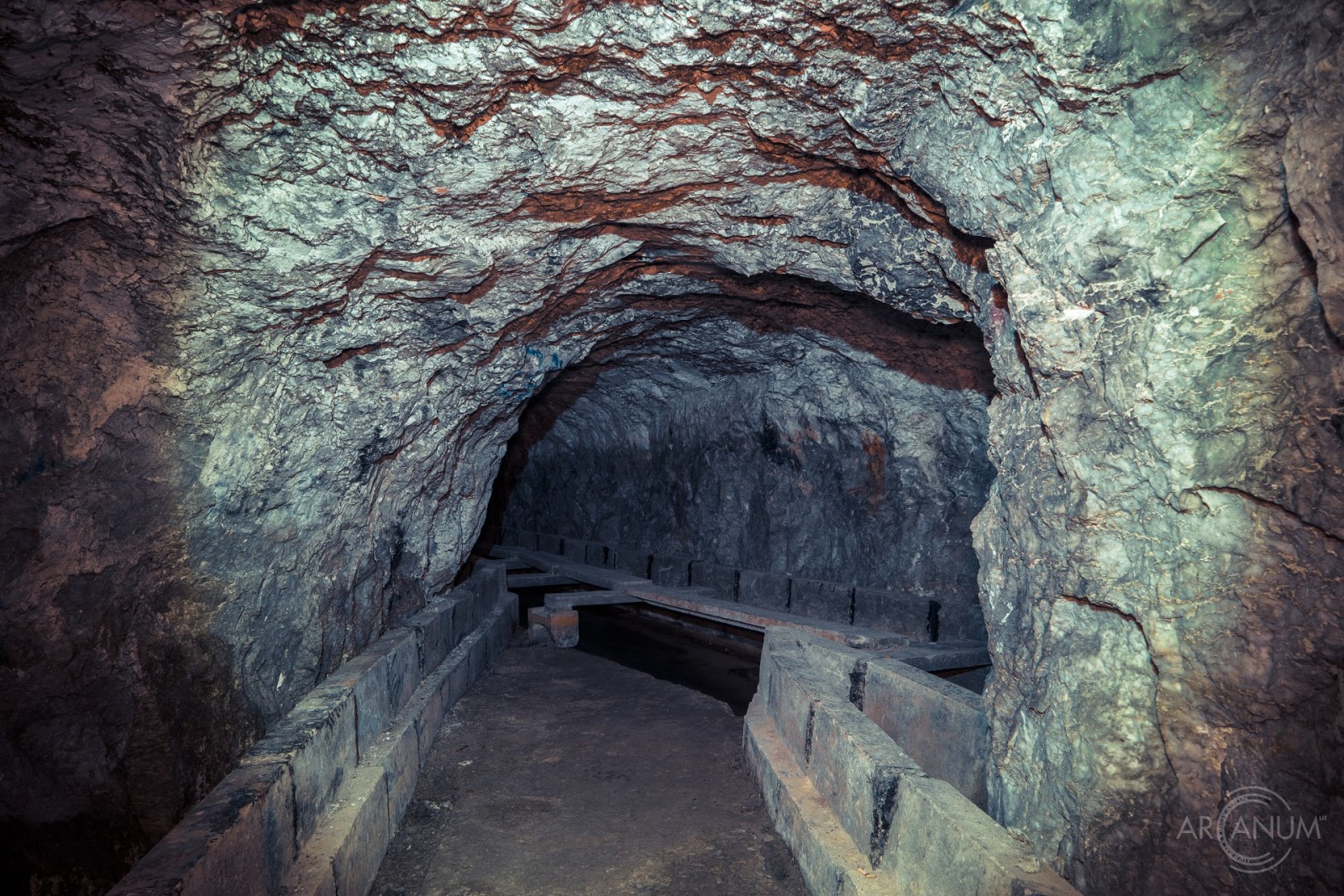
From the maps that I'd studied during my research, I knew that the shaft was about ten meters deep, but it was pitch black and narrow, so once you were in, you really couldn't see anything. As I had made it down the old rusty step ladder, I directed my wife down. When we had both arrived at the bottom, we started walking along the tunnel. It was dry art first, but after a while, it became too wet, so we switched shoes and put on our rubber boots. That first part of the tunnel was big enough for us to stand up, but as soon as we reached the real drainage tunnel, there was only a concrete walkway to walk on with the water flowing underneath, so from that point on, we had to go crouched and at the same time watch out not to step off the narrow walkway.
After a while, we reached the intersection that was going to lead us to the cave. At the end of that next tunnel, there were a couple of stairs that had been cut into the stone. Up the stairs, and the light of our flashlights disappeared into the darkness of the cave.
Since this cave has no natural accesses, there are no animals inside, and it was completely silent. It is a karst cave, and the rugged walls disperse every sound so everything sounds strangely muffled.
The cave was relatively small, but still seemed enormous to us, who had never been alone in a dark cave that was not a tourist attraction. We took our time and climbed around a bit in the cave and took a few photos - but the cave wasn't really photogenic. There were no stalagmites or stalactites only rubble from the cave's walls. And you could see the form of the tunnel underneath this rubble.
After about 45 minutes inside the cave, we decided to call it a day. After all - there was still the way back to the car and the drive to the bed & breakfast that we'd rented a room in for the weekend. Additionally, we had planned to visit our friend Jens at the old sanatorium for a barbecue that night, so we also had planned to go shopping for some groceries.
Since we already took the tough way in, we took the easy way out. We waited for the break between two trains going through the tunnel, and walked from the cave through the door right into the tunnel.
Yes, there was a door. It was put there by the railroad company for maintenance purposes, and we knew from the beginning that it was there.
But we thought that the adventure would be better if we took the long way in - and we were right! It really was a little adventure climbing down a shaft, walking through tunnels into a mountain and exploring a cave.
To find out about the history of this place and to check out more galleries from abandoned places, click the button below.
You can check out the short video I made of our exploration here: