March 16, 2023

Tour Report: Soviet Garrison H. [Revisit]

The second location that we explored during our spontaneous tour in May of 2019 was an abandoned Soviet Garrison. I had visited the place, which had been built as part of an airfield by the Nazis in 1935/36, twice before in 2014 and 2015. For me, it is always interesting to see what happens to an abandoned building in long periods between visits. Is it still accessible at all? Has demolition or renovation started? If not, what is the condition, and how did the decay develop over the years? These are always the questions that I ask myself before a revisit.
In this case, not much had changed in the four years since my second visit.
The more or less "official" parking spot was still there, and there still were no real fences around the building. However, a lot of the windows and doors on the lower floor had been boarded up, so we had to look a little longer until we found an opening.
We climbed through a window and started walking the hallways of the curved, 500 meter long building.
The afternoon sun and the green trees in front of the windows projected beautiful patterns of light, shadow and color into the rooms. The decay was more intense than before - but then, after almost thirty years of deterioration, you can't really tell...
Towards the end our walkthrough, I decided to check out the basement one more time - and it was a good thing, too, because I did find a few Soviet documents as well as some propaganda posters. This was yet another proof that you really have to check everywhere if you want to find all the interesting stuff :)


To find out about the history of this place and to check out all the photos, click the button below.


March 5, 2023

Tour Report: Soviet Airfield LT [Revisit]

For a spontaneous tour in May 2019 together with two friends, who were relatively new to the hobby of urban exploration, we decided to revisit two abandoned Soviet military facilities that were pretty easy in terms of access and had only little potential of encountering a security service patrolling the place.

The first spot that we drove to was an abandoned former airfield that I had first visited in 2016. I do like revisits, because they give you the chance to see what effect time (and people) has had on buildings, and because you can take shots that you may have missed the first time.

After a drive of a little more than two hours, we arrived at the location. It was exactly like I remembered: A parking space right in front - and no fences around the hangars. Only the former reconnaissance school had been surrounded with a game fence, but that fence had already been pushed down in a lot of places, so we were free to move around.

It was late in May, so compared to my first visit, which was in November, the place was much greener, and the decay looked much more intense and colorful, which I really enjoyed. We took our time exploring every small building that we could find, checking out all the rooms and looking into every basement. It took about two hours, then we got back to the cars - we had yet another Soviet place to visit...


To find out about the history of this place and to check out all the photos, click the button below.


February 25, 2023

Tour Report: Underground Junkers Factory

Continuing our tour in May of 2019, we left the abandoned "Sanatorium Hydro" to explore a place that played a part in Germany's arms industry during World War II.
Since 1943, the Nazi government had decided to relocate war-related factories underground. The companies found space mostly in old mines, railway tunnels, caverns or in newly created tunnels.
The manufacture of wings for the Ju 88 night fighter and the partial manufacture of cells for the Ju 88 and Ju 162 were among the production facilities that were relocated underground for bomb-proof production. They were relocated into a cave system in the Harz mountains that was previously used for beer storage by a restaurant in the nearby city.

We parked the car and started walking the path that took us up the hill until we reached a fence surrounding a (possibly) vacation home. There was an open door through which we could see a small entrance into the rocky wall of the mountain. We didn't know if the buildings were still in operation - it looked like the lawn was mown regularly - so we only took a quick peek. Behind the small entrance was access into the mountain, but we didn't see any way further in. So we retreated from the garden and made our way a little further up until we reached the second part of the cave system. It was wide open and easily accessible.

The day was warm, but upon entering, cool air surrounded us, which was very pleasant after the long and exhausting ascent.
Exploring places like this always is a bit ambivalent for me. On the one hand, almost 80 years ago, forced labor was used to prepare these places for production and for the production itself - so after all, the place is a place of terrible human suffering.
On the other hand, if you don't know about its history, the cave nowadays is just that - a cave, and a beautiful and exciting location to explore.

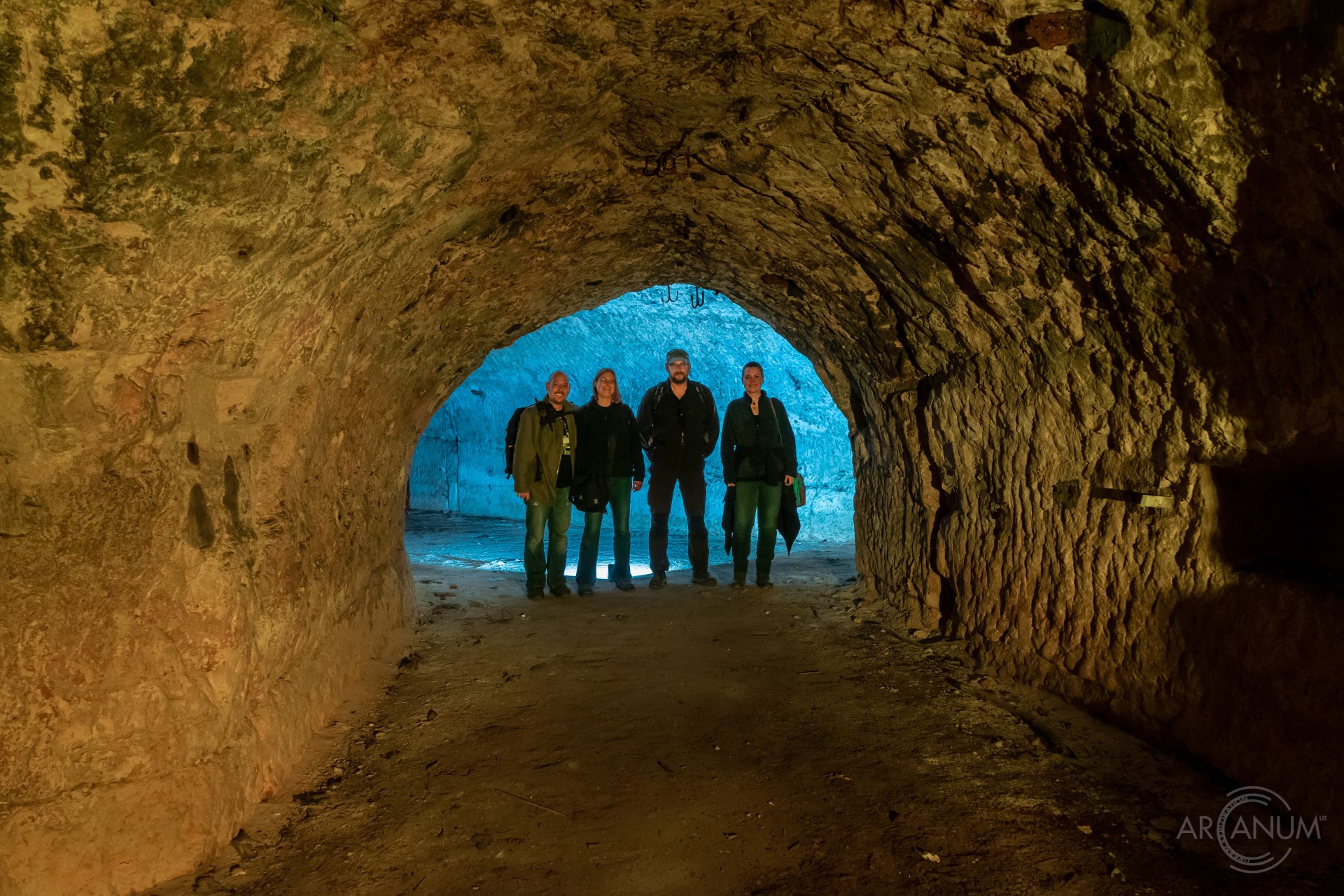
We didn't find any real relics from World War II - only a few brick walls and remains of steel beams tell the story of this cave as a war factory. When we had checked all rooms of the cave, we spent a little time flooding the place with lights of various colors - something that I had not tried before. The photos came out quite okay, I think.

I do hope that I will have the chance to explore the other parts of the cave system in the future - after all, this exploration is still incomplete ;)


To find out about the history of this place and to check out all the photos, click the button below.


Related Posts Plugin for WordPress, Blogger...