September 23, 2024

Tour Report: Soviet Ammunitions Depot R.

It was our last tour of 2019 and we had made our way to Mecklenburg-Western Pomerania with a friend to celebrate New Year's Eve at a good friend's house.
On the way, we made a short stopover to see another Soviet relic near the Lärz airfield.
Over the years we had already explored not only the airfield itself but also the bunker of the fighter control center and the command post of the 125th Fighter Bomber Division as well as the local Soviet garrison.
The object of this tour was the airfield's ammunition depot. Many Soviet airfields had two separate depots for ammunition. One depot was used to store conventional ammunition, while some airfields also had an area for storing nuclear ammunition.
In the case of Lärz airfield, the storage bunker for nuclear bombs is used by a branch of the munitions recovery service.
This bunker is located directly on the border of the airport grounds.
The ammunition depot for conventional ammunition is located a good distance north of the airfield and approx. 1.6 kilometers east of the former Soviet garrison.
On satellite images and maps, it looked as if the area was openly accessible, and so it was. We were able to park directly on the road and walked the rest of the way. We could see from the vehicle tracks that the area was probably being used as a storage site by the forestry authority.
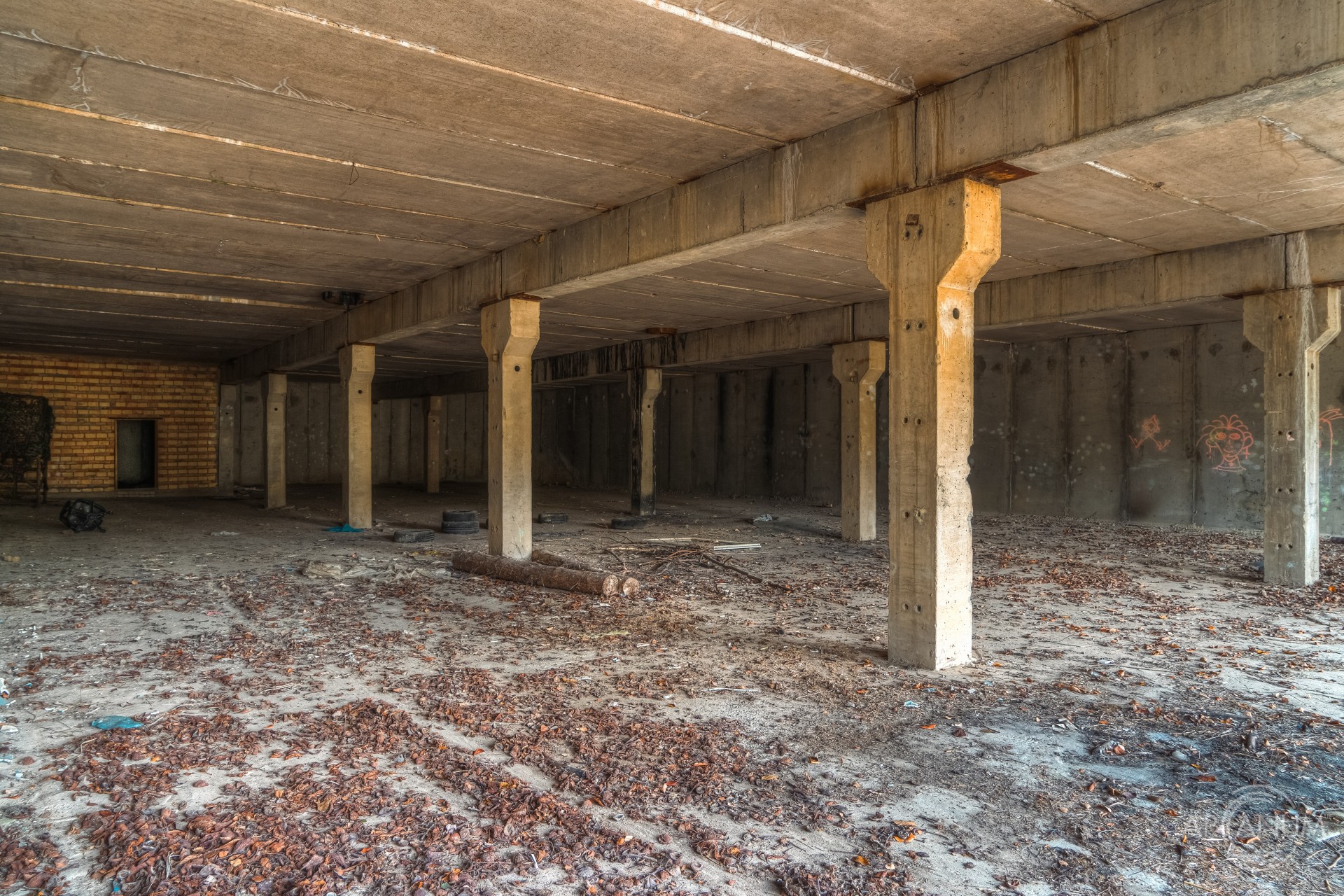
That's why there wasn't much for us to see. The two large storage bunkers, the warehouses and the vehicle garage were locked. Only the protected vehicle hall was open and accessible. But even here there wasn't much to see apart from a bit of garbage.
So we didn't spend too much time on the site and made our way relatively quickly to another location.


To find out about the history of this place and to check out all the photos, click the button below.




September 11, 2024

Tour Report: Zoological Museum "Animal House"

The last location we explored on our 2019 Christmas tour of Denmark was an abandoned zoological museum. I had been tipped off about this place and told that there wasn't much left to see.
We found the location on a lonely country road in the middle of Denmark. There was one house on each side of the road. As there were no neighbors in the vicinity, we parked directly on site.
We first took a look at the smaller of the two buildings. Hanging out of an open window was a pelt that had probably once belonged to a badger. The door was open so that we could easily enter the house.
Inside, we found all sorts of things: animal skins and bones, wood, straw, jars of chemicals - and business documents. These showed that a taxidermist had worked in the house. He apparently not only made the specimens for the zoological museum, but also for private customers.
The lion we found was particularly impressive. The fur was on the first floor, but in the attic we found the almost complete frame made of wire and straw.
Equally interesting were the many empty jars of chemicals, mostly phenol and arsenic trioxide. Both are or were used in embalming and taxidermy.
After we had fully explored the taxidermist's house, we simply walked across the street. The building opposite housed the so-called zoological museum.
Unfortunately, there wasn't much left to see there because, on the one hand, a large part of the collection was sold after the museum was closed and, on the other hand, the vandals or local teenagers have of course already struck.
So the “cages” were empty with the exception of a few decorations - but you could still see that someone had obviously put a lot of effort into the museum's layout.
As it was already relatively late in the afternoon, I only took my cell phone with me to take photos. But I should be back a few weeks later for another visit, so stay tuned!

To find out about the history of the place and to check out all the photos, click the button below.


August 30, 2024

Tour Report: Farmhouse "Henry"

After discovering and photographing the farmhouse with all the beautiful vintage cars, we made our way to the second location on our 2019 Christmas tour.
In this case, too, I had been given a tip that there were some beautiful old cars on the property. Plus, the place wasn't too far away from the first spot, so we only had to drive for about thirty minutes to get there.
The nearest residential buildings were far away, so we were able to park conveniently right next to the location.
The old farmhouse consists of a residential building connected at right angles to two farm buildings. Opposite is a large barn. The residential building was completely empty and didn't really offer any good photo opportunities, nor did the two farm buildings, which were in a terrible state of disrepair inside.
The barn didn't make a spectacular impression from the outside either: there was a lot of garbage lying around outside the barn door, the walls were thin and shaky, and the roof didn't make the best impression either.
On the other hand, it was very easy to get in because the barn door was slightly open, so we only had to climb over the garbage to get in.
Inside we found... vintage cars!
Most of the cars were Ford models. I particularly liked the Ford Taunus XL and the Ford Taunus Coupe GT from the early 1970s. These models are also known as the “Knudsen Taunus” due to the characteristic protrusion in the radiator grille, named after the former chairman of the board Semon E. “Bunkie” Knudsen.
In addition to the “Knudsen-Taunus”, we also found other representatives of the Ford family: a Ford Escort from the 1980s and a British Ford Thames 400E van.
Another little treasure was the Renault 8 (R8 for short), which probably dates from the mid-1960s.
Less spectacular were the two Daihatsu Charades from the 1980s.

To check out all the photos from this amazing place, click the button below.


Related Posts Plugin for WordPress, Blogger...